
Situada en el corazón de Barcelona, la Biblioteca Pública Arús representa uno de los espacios culturales más singulares de Europa. Su legado histórico, su vínculo con el pensamiento social y su extraordinaria colección dedicada a Sherlock Holmes la convierten en un enclave imprescindible para investigadores, lectores y amantes del universo detectivesco.
Conversamos con su Directora sobre memoria, cultura, investigación y el papel de las bibliotecas en una sociedad dominada por la inmediatez digital.
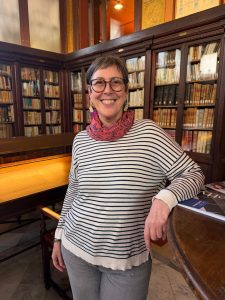
Maribel Giner Molina es la directora gerente de la Biblioteca Pública Arús desde el año 2015, después de haber ejercido la dirección desde 1991. Diplomada en Biblioteconomía y Documentación y licenciada en Historia Contemporánea por la Universidad de Barcelona, ha dedicado buena parte de su carrera profesional a la gestión, conservación y difusión del patrimonio bibliográfico y documental.
Al frente de la Biblioteca Pública Arús, ha impulsado la preservación y la proyección de un referente dentro de los centros patrimoniales especializados en historia social contemporánea, movimiento obrero, anarquismo, masonería y la colección dedicada a Sherlock Holmes. También ha promovido numerosas exposiciones, actividades culturales, publicaciones y proyectos de investigación orientados a acercar este patrimonio a la ciudadanía y a la comunidad investigadora.
Es autora de diversos trabajos sobre la Biblioteca Pública Arús, entre los cuales destaca el artículo La Biblioteca Arús. La primera biblioteca pública de Barcelona (2016), dónde repasa la historia de la institución, sus principales fondos y sus retos de futuro.
La Biblioteca Pública Arús ocupa un lugar único dentro del patrimonio cultural de Barcelona. ¿Qué representa hoy esta institución para la ciudad y para quienes la descubren por primera vez?
La Biblioteca Pública Arús ocupa una posición muy especial dentro del patrimonio bibliográfico y documental de Barcelona.
Su atractivo no se explica únicamente por sus fondos. Quien cruza sus puertas por primera vez descubre con sorpresa un espacio con personalidad propia, donde documentos e historia se dan la mano de manera natural. Puede que no sea uno de los lugares más conocidos de la ciudad, pero, desde luego, es uno de esos espacios que dejan huella y que ayudan a entender mejor una parte importante de la Barcelona y la Cataluña contemporáneas.
Muchas personas asocian la Biblioteca Arús con Sherlock Holmes, pero su legado va mucho más allá. ¿Qué aspectos históricos y culturales considera más importantes dentro de su identidad?
Es cierto que hay quien asocia la Biblioteca Pública Arús con Sherlock Holmes, y no es para menos, ya que cuenta con una de las colecciones dedicadas al detective más importantes de Europa. Esta colección se incorporó en 2011 gracias a la donación de Joan Proubasta. Esta asociación, sin embargo, explica solamente una pequeña parte de su historia, ya que la Biblioteca abrió sus puertas en 1895.
Rossend Arús creó la Biblioteca Arús con la voluntad de que fuera una biblioteca general para todos los ciudadanos, sin distinción de sexo, edad o condición social. Era una idea avanzada para su tiempo, estrechamente ligada a la convicción de que el conocimiento debe ser accesible para todos y de que este contribuye a la libertad.
Aunque nació como biblioteca generalista, hoy es, sobre todo, un centro de investigación especializado en tradición republicana federal, catalanismo y movimiento obrero —en especial, el anarquismo— del siglo XIX y del primer tercio del XX, así como en masonería y el universo de Sherlock Holmes.
La Biblioteca cuenta también con un amplio fondo patrimonial de alcance general, constituido en gran parte por obras publicadas entre el siglo XIX y comienzos del siglo XX. Es una colección histórica que ha dejado de actualizarse, pero que sigue constituyendo un testimonio muy valioso de los intereses culturales e intelectuales de la época.
La institución mantiene, más de cien años después de su fundación, la vocación original que la ha definido. La colección de Joan Proubasta de Sherlock Holmes ha servido para acercarla a nuevos públicos, pero la verdadera singularidad de la Biblioteca Arús reside tanto en la riqueza y diversidad de sus colecciones como en la vigencia del proyecto cultural que inspiró su creación hace más de ciento treinta años.
¿Cómo ha evolucionado el perfil de visitantes e investigadores en los últimos años?
Yo distinguiría entre las personas que visitan la exposición, las que consultan el fondo y utilizan la sala de lectura, las que participan en las actividades y las que visitan la Colección Joan Proubasta de Sherlock Holmes.
En la sala de lectura el cambio ha sido más de perfil que de cantidad. Antes predominaba un uso más puntual y definido, principalmente por parte de investigadores que acudían a consultar el fondo. Ahora el perfil es más diverso. Hay estudiantes en momentos concretos, personas que traen sus propios libros, usuarios que combinan la consulta presencial con los recursos digitales y también quienes entran por primera vez, descubren el espacio y regresan posteriormente. No se trata de una afluencia masiva, pero sí más variada que antes.
Con las actividades sucede algo parecido, aunque en este caso se aprecia una mayor continuidad gracias a la programación cultural que organizamos de octubre a junio, sobre todo las tardes de los martes y jueves. Son propuestas vinculadas a nuestro fondo especializado que contribuyen a darlo a conocer. El público suele ser más asiduo, aunque varía en función de la temática propuesta.
El ambiente de las salas y el peso de todo lo que ha sucedido en ellas despiertan también un interés general. Por esta razón, organizamos visitas guiadas a través de Cases Singulars, que permiten conocer la historia de la Biblioteca y de su edificio.
Por otro lado, está la Colección Joan Proubasta de Sherlock Holmes, que funciona de manera diferente. No es de libre acceso, pero puntualmente se organizan visitas guiadas. Recibimos a un público muy específico: algunos investigadores especializados y, sobre todo, aficionados que ya conocen bien el tema y quieren descubrir la colección en persona. En el fondo holmesiano se produce esa combinación entre el interés académico y el de los aficionados, aunque de manera puntual y sin un gran volumen de visitantes.
En este sentido, estamos buscando fórmulas para dar mayor visibilidad a la colección, explorando nuevas maneras de explicarla y acercarla a otros públicos.
Son distintas formas de utilizar la Biblioteca, y eso es lo que realmente ha ido cambiando.

En una época dominada por lo digital y la velocidad, ¿cree que las bibliotecas históricas han adquirido un nuevo valor simbólico?
Sí, yo diría que sí, aunque la Biblioteca Arús no es únicamente una biblioteca histórica, sino también un espacio vivo. Precisamente por este motivo, hace varios años iniciamos el proyecto «BibliotecaViva» para reivindicar su actualidad.
En una época en la que todo sucede muy deprisa y gran parte de nuestra actividad se desarrolla a través de una pantalla, las bibliotecas históricas corren el riesgo de estancarse. Por ello es necesario buscar nuevas dinámicas que permitan mantenerlas vivas.
En un momento en el que casi todo se disputa nuestra atención, espacios como este siguen ofreciendo la posibilidad de detenerse, observar y pensar sin prisas. La Biblioteca nació con la voluntad de proporcionar conocimiento y fomentar el pensamiento crítico. Esa capacidad, que a veces parece olvidada, continúa siendo de plena actualidad.
Por tanto, sí, es posible que las bibliotecas históricas hayan adquirido un nuevo valor simbólico. No porque compitan con la realidad digital, sino precisamente porque ofrecen algo diferente.
La preservación documental exige una enorme responsabilidad. ¿Qué significa para ustedes custodiar este patrimonio intelectual e histórico?
Mantener este patrimonio implica una combinación de responsabilidad y cuidado constante. No se trata simplemente de guardar libros o documentos en una estantería.
Cada pieza que forma parte de nuestros fondos contribuye a preservar la memoria colectiva. Hay materiales que, si se pierden, son irremplazables, y eso obliga a trabajar con mucha atención.
También es necesario mantener un equilibrio entre conservar y divulgar. No basta con proteger el fondo: debe poder ser consultado, utilizado e interpretado. De lo contrario, queda convertido en algo cerrado, casi dormido, y pierde parte de su sentido.
A ello se suma todo el trabajo cotidiano que resulta menos visible: ordenar, describir, conservar y, cuando es necesario, restaurar. Son tareas que pueden parecer pequeñas, pero que sostienen todo lo demás.
En definitiva, trabajamos en un equilibrio delicado: proteger suficientemente el patrimonio para garantizar su conservación y, al mismo tiempo, facilitar el acceso necesario para que continúe teniendo vida.
¿Qué papel juega la Biblioteca Arús en la difusión de la cultura detectivesca y del universo de Sherlock Holmes en España?
La Biblioteca Arús mantiene una vinculación muy especial con el universo de Sherlock Holmes. Con el tiempo, nuestra colección holmesiana, una de las más importantes de Europa, nos ha convertido en un punto de encuentro para lectores, investigadores y amantes del personaje.
Resulta interesante comprobar que Sherlock Holmes hace tiempo que dejó de pertenecer exclusivamente al ámbito de los libros. Algunos lectores llegan a la Biblioteca después de haber leído a Conan Doyle, pero muchos otros descubren al detective a través del cine o de las series de televisión. Cada generación descubre, de alguna manera, a su propio Sherlock Holmes.
Por ello intentamos que las actividades reflejen esa diversidad de intereses. Colaboramos estrechamente con el Círculo Holmes y con el Col·legi Oficial de Detectius Privats de Catalunya, con los que organizamos conferencias, encuentros y distintas propuestas divulgativas. Son actividades que suelen generar conversaciones muy enriquecedoras, ya que reúnen perfiles muy diversos: lectores, especialistas, coleccionistas, investigadores profesionales y personas que simplemente sienten curiosidad.
Nos parece especialmente interesante, además, el diálogo que se establece entre la ficción y la realidad. Holmes nació como personaje literario, pero su manera de observar, analizar los detalles y razonar ha calado de tal manera en el imaginario colectivo que se ha convertido en un referente que va mucho más allá de los cuentos y las novelas.
Comprobar cómo una obra escrita hace más de un siglo continúa generando interés a través de libros, películas, series y actividades culturales demuestra la extraordinaria vigencia del personaje. Para nosotros es un placer contribuir a mantener viva esta tradición desde Barcelona.
¿Existe actualmente un renovado interés por la literatura de misterio, investigación y crimen?
En la Biblioteca Arús pensamos que sí. Algunas personas acuden buscando a Sherlock Holmes casi con devoción y están muy vinculadas a la obra original, mientras que otras se acercan más por el género del crimen real o por la investigación contemporánea. En el fondo, todas comparten una misma inquietud: seguir pistas, reconstruir hechos y comprender qué hay detrás de ellos.
La colección holmesiana se encuentra actualmente en una fase de trabajo interno. Queda todavía por catalogar el fondo y, poco a poco, se va ordenando gracias a la ayuda de Josep Maria Clavell, especialista en Sherlock Holmes y miembro del Círculo Holmes. Es un proceso lento que requiere tiempo, paciencia y recursos.
Mientras tanto, la colección puede visitarse tal como se encuentra actualmente, en conjunto y con pocas explicaciones. Esto produce un efecto curioso, porque muchos visitantes se sorprenden al encontrarse directamente ante todos esos materiales. Es una experiencia difícil de explicar con palabras; hay que verla.
También contamos con una recreación del despacho de Sherlock Holmes, que suele ser uno de los elementos más llamativos y sorprendentes de la visita.
Además, organizamos visitas guiadas de manera puntual y abrimos el espacio en fechas concretas, como durante la BCNegra, siempre con inscripción previa. El ambiente del festival y las características de la colección encajan de una manera muy natural.
Desde su experiencia, ¿qué relación existe entre investigación, observación y conocimiento histórico?
Están estrechamente relacionados, aunque no siempre resulte evidente desde fuera.
Normalmente, la investigación comienza con una hipótesis de trabajo, una pregunta que se sale de la norma, un dato que no encaja o un aspecto todavía desconocido. Es entonces cuando entra en juego el método científico. No se trata simplemente de mirar, sino de observar con atención: un detalle en un margen, una fecha que difiere entre dos fuentes o un documento que no concuerda completamente con otro.
A partir de esas observaciones se construye progresivamente el conocimiento histórico. Es un proceso que exige contrastar fuentes, revisar datos y, en ocasiones, corregir interpretaciones que inicialmente parecían claras.
Esto se observa con frecuencia en la Biblioteca. Hay investigadores que llegan con una línea de investigación muy definida y que, al trabajar directamente con la documentación, terminan ajustándola o incluso replanteándola.
La observación, por tanto, permite que la investigación avance, y la investigación evita que nuestra interpretación de la historia quede fijada de manera definitiva. Aunque trabajemos con documentos que permanecen físicamente inalterados, la lectura y la interpretación que hacemos de ellos están en constante evolución.
La Biblioteca Arús posee una atmósfera muy especial. ¿Cree que ciertos espacios culturales conservan todavía una capacidad de inspirar imaginación y pensamiento crítico?
Sin duda. Una biblioteca como esta, que nació con la voluntad de instruir a las clases trabajadoras, continúa fomentando el pensamiento crítico a través de su arquitectura, su fondo documental y un entorno que invita a detenerse y reflexionar.
Muchos escritores se acercan a la Biblioteca en busca de inspiración. Algunos vienen a documentarse, pero terminan llevándose mucho más. Hay rincones que parecen sugerir personajes, salas que podrían formar parte de una novela y detalles que despiertan inmediatamente la curiosidad. En ocasiones, nuestros espacios terminan convirtiéndose incluso en escenarios literarios.
¿Qué proyectos o iniciativas futuras le gustaría impulsar desde la Biblioteca?
Hay muchas ideas sobre la mesa, pero, si tuviera que señalar una prioridad, diría que queremos que la Biblioteca sea cada vez más accesible y visible, sin perder aquellos elementos que la hacen única.
La Biblioteca es reconocida en el ámbito de las bibliotecas especializadas y en el universitario, pero todavía hay muchas personas que la desconocen y se sorprenden cuando la visitan. Por eso nos interesa seguir abriéndola a nuevos públicos, especialmente a los más jóvenes, y encontrar formas de acercarles un patrimonio que, aunque hable del pasado, sigue teniendo mucho que decir sobre el presente.
También nos gustaría continuar avanzando en la informatización y digitalización de nuestros fondos. No se trata únicamente de conservar los documentos, algo que ya es fundamental, sino también de hacerlos accesibles a investigadores, estudiantes y personas interesadas desde cualquier lugar.
Otro aspecto que considero fundamental es mantener viva la Biblioteca como lugar de encuentro. Nos gusta que aquí sucedan cosas, que los historiadores compartan sus hallazgos, que se organicen actividades y que los escritores encuentren inspiración entre estas paredes.
En definitiva, el objetivo es bastante sencillo: que alguien entre por curiosidad y se vaya con ganas de volver. Si dentro de unos años seguimos consiguiéndolo, creo que iremos por buen camino.
¿Cómo vivió personalmente la presentación del libro El sueño americano de Eugenio Vélez Troya dentro de la Biblioteca Arús?
Personalmente, la disfruté mucho. Creo que fue un acierto que la investigadora Esther Gómez condujera la conversación. Como detective en activo, aportó una perspectiva muy cercana y, además, el entorno de la Biblioteca Arús contribuyó a crear un ambiente especial.
Desde el principio hubo muy buena conexión entre Esther Gómez, la autora Nina Vélez-Troya y las personas asistentes. Se percibía que el público escuchaba con atención, lo que hizo que la conversación fuera muy dinámica.
Como biblioteca, nos hace mucha ilusión comprobar que las actividades funcionan y que sirven para acercar a escritores, historiadores y lectores en un espacio como el nuestro. Ese es, precisamente, uno de nuestros objetivos: difundir los fondos de la Biblioteca y consolidarla como lugar de encuentro y conversación.
¿Qué importancia tiene mantener vivo el legado de figuras históricas vinculadas al mundo de la investigación y la criminología?
Creo que es importante porque nos ayuda a comprender de dónde proceden muchas de las técnicas y formas de trabajar que hoy damos por sentadas. Conocer a las personas que contribuyeron al desarrollo de la investigación y la criminología también permite valorar mejor su trabajo y comprender el contexto en el que lo llevaron a cabo.
Además, este tipo de actividades contribuye a que esas figuras no queden relegadas a los libros, sino que vuelvan a formar parte de la conversación. Si conseguimos despertar el interés por su historia y por sus aportaciones, será mucho más fácil preservar su legado y mantenerlo vigente en la actualidad.
Maribel Giner, Director of the Arús Public Library
Located in the heart of Barcelona, the Arús Public Library is one of Europe’s most distinctive cultural institutions. Its historical legacy, its close ties to social thought, and its extraordinary Sherlock Holmes collection make it an essential destination for researchers, readers and enthusiasts of the detective world.
We spoke with its Director about memory, culture, research and the role of libraries in a society dominated by digital immediacy.
Maribel Giner Molina has served as Executive Director of the Arús Public Library since 2015, after having previously directed the institution from 1991 onwards. She holds a Diploma in Library and Information Science and a degree in Contemporary History from the University of Barcelona. Throughout her career, she has devoted herself to the management, preservation and dissemination of bibliographic and documentary heritage.
Under her leadership, the Arús Public Library has strengthened its position as one of Spain’s leading heritage institutions specialising in contemporary social history, the labour movement, anarchism, Freemasonry and the renowned Sherlock Holmes Collection. She has also promoted numerous exhibitions, cultural programmes, publications and research projects aimed at bringing this remarkable heritage closer to both the general public and the academic community.
She is the author of several publications on the Arús Public Library, including The Arús Library: Barcelona’s First Public Library (2016), in which she explores the institution’s history, its most significant collections and the challenges that lie ahead.
People to discover their stories and understand their contributions, it becomes far more likely that their legacy will endure and continue to hold meaning for future generations.
The Biblioteca Pública Arús occupies a unique place in Barcelona’s cultural heritage. What does the institution represent today for the city and for those discovering it for the first time?
The Biblioteca Pública Arús holds a very special place within Barcelona’s bibliographic and documentary heritage.
Its appeal cannot be explained by its collections alone. Those who walk through its doors for the first time are often surprised to discover a space with a character all its own, where documents and history come together naturally. It may not be one of the city’s best-known landmarks, but it is certainly one of those places that leaves a lasting impression and helps us better understand an important part of contemporary Barcelona and Catalonia.
Many people associate the Biblioteca Arús with Sherlock Holmes, but its legacy extends far beyond that. Which historical and cultural aspects do you consider most important to its identity?
It is true that some people associate the Biblioteca Pública Arús with Sherlock Holmes, and understandably so, as it houses one of Europe’s most important collections devoted to the detective. The collection was acquired in 2011 thanks to a donation from Joan Proubasta. However, this association represents only a small part of the Library’s history, as it first opened its doors in 1895.
Rossend Arús founded the Biblioteca Arús with the intention of creating a general library for all citizens, regardless of sex, age or social status. It was a progressive idea for its time, closely linked to the belief that knowledge should be accessible to everyone and that access to knowledge contributes to freedom.
Although it was founded as a general library, today it is primarily a research centre specialising in the federal republican tradition, Catalanism and the labour movement —particularly anarchism— of the nineteenth century and the first third of the twentieth century, as well as Freemasonry and the world of Sherlock Holmes.
The Library also holds an extensive general heritage collection, largely comprising works published between the nineteenth and early twentieth centuries. It is a historical collection that is no longer being expanded, but it remains an invaluable record of the cultural and intellectual interests of its time.
More than a century after its foundation, the institution remains true to the original mission that has defined it. The Joan Proubasta Sherlock Holmes Collection has helped us reach new audiences, but the true uniqueness of the Biblioteca Arús lies both in the richness and diversity of its collections and in the enduring relevance of the cultural project that inspired its creation more than 130 years ago.
How has the profile of visitors and researchers evolved in recent years?
I would distinguish between people who visit the exhibition, those who consult the collections and use the reading room, those who take part in our activities, and those who visit the Joan Proubasta Sherlock Holmes Collection.
In the reading room, the change has been more about the profile of users than their numbers. In the past, use tended to be more occasional and clearly defined, mainly involving researchers who came to consult the collections. Today, the profile is more diverse. We see students at certain times, people who bring their own books, users who combine on-site consultation with digital resources, and also people who come in for the first time, discover the space and later return. We are not talking about large numbers, but the range of users is certainly more varied than before.
Something similar has happened with our activities, although in this case there is greater continuity thanks to the cultural programme we run from October to June, particularly on Tuesday and Thursday evenings. These activities are linked to our specialised collections and help raise awareness of them. The audience tends to be more regular, although it varies depending on the subject of each event.
The atmosphere of the rooms and the weight of everything that has taken place within them also generate broader interest. For this reason, we organise guided tours through Cases Singulars, allowing visitors to discover the history of both the Library and the building itself.
Then there is the Joan Proubasta Sherlock Holmes Collection, which operates somewhat differently. It is not freely accessible, although guided tours are occasionally organised. It attracts a very specific audience: some specialist researchers and, above all, enthusiasts who are already familiar with the subject and want to experience the collection in person. The Holmes collection brings together academic interest and the enthusiasm of dedicated fans, although visits are occasional and numbers are relatively small.
In this respect, we are looking for ways to give the collection greater visibility, exploring new approaches to interpreting it and making it accessible to a wider range of audiences.
These are different ways of engaging with the Library, and that is what has really changed.
In an age dominated by digital technology and speed, do you think historical libraries have acquired a new symbolic value?
Yes, I would say so, although the Biblioteca Arús is not simply a historical library; it is also a living space. This is precisely why, several years ago, we launched the “BibliotecaViva” project to show that the Library is still very much alive and relevant today.
At a time when everything moves very quickly and so much of our activity takes place through screens, historical libraries run the risk of becoming static. We therefore need to explore new approaches that allow them to remain vibrant and relevant.
At a time when almost everything competes for our attention, spaces like this still offer us the opportunity to stop, observe and think without rushing. The Library was founded with the aim of providing access to knowledge and fostering critical thinking. That capacity, which can sometimes seem forgotten, remains entirely relevant today.
So yes, historical libraries may indeed have acquired a new symbolic value. Not because they compete with the digital world, but precisely because they offer something different.
Preserving documentary heritage carries an enormous responsibility. What does safeguarding this intellectual and historical heritage mean to you?
Looking after this heritage involves a combination of responsibility and constant care. It is not simply a matter of placing books or documents on a shelf.
Every item in our collections contributes to preserving our collective memory. Some materials are irreplaceable if lost, and that requires us to work with great care.
It is also essential to strike a balance between preservation and dissemination. Protecting the collections is not enough: they must be available for consultation, use and interpretation. Otherwise, they become something closed off, almost dormant, and lose part of their purpose.
Then there is all the less visible day-to-day work: organising, cataloguing, preserving and, when necessary, restoring materials. These tasks may seem minor, but they underpin everything else we do.
Ultimately, we work within a delicate balance: protecting the heritage sufficiently to ensure its preservation while, at the same time, providing the access necessary to keep it alive.
What role does the Biblioteca Arús play in promoting detective culture and the world of Sherlock Holmes in Spain?
The Biblioteca Arús has a very special connection with the world of Sherlock Holmes. Over time, our Holmes collection, one of the most important in Europe, has made the Library a meeting point for readers, researchers and enthusiasts of the character.
It is interesting to see how Sherlock Holmes ceased long ago to belong exclusively to the world of books. Some readers come to the Library after reading Conan Doyle, while many others discover the detective through films or television series. In a sense, every generation discovers its own Sherlock Holmes.
We therefore try to ensure that our activities reflect this diversity of interests. We work closely with the Círculo Holmes and the Col·legi Oficial de Detectius Privats de Catalunya, with whom we organise lectures, meetings and a variety of outreach activities. These events often generate very enriching conversations because they bring together a wide range of people: readers, specialists, collectors, private investigators and those who are simply curious.
We are also particularly interested in the dialogue between fiction and reality. Holmes began as a literary character, but his way of observing, analysing details and reasoning has become so deeply embedded in the collective imagination that he has grown into a cultural reference point extending far beyond the original stories and novels.
The fact that a body of work written more than a century ago continues to inspire interest through books, films, television series and cultural activities demonstrates the extraordinary enduring appeal of the character. For us, it is a pleasure to help keep this tradition alive from Barcelona.
Is there currently a renewed interest in mystery, investigation and crime literature?
At the Biblioteca Arús, we believe there is. Some people come looking for Sherlock Holmes almost with a sense of devotion and are deeply connected to the original works, while others are drawn more to true crime or contemporary investigation. Ultimately, they all share the same curiosity: following clues, reconstructing events and understanding what lies behind them.
The Holmes collection is currently undergoing internal work. The collection still needs to be catalogued and is gradually being organised with the help of Josep Maria Clavell, a Sherlock Holmes specialist and member of the Círculo Holmes. It is a slow process that requires time, patience and resources.
In the meantime, the collection can be visited as it currently stands, as a whole and with relatively little interpretation. This creates an interesting effect, as many visitors are surprised to find themselves directly surrounded by all these materials. It is an experience that is difficult to put into words; you must see it for yourself.
We also have a recreation of Sherlock Holmes’s study, which is usually one of the most striking and surprising elements of the visit.
We also organise occasional guided tours and open the space on specific dates, such as during the BCNegra festival, always with prior registration. The atmosphere of the festival and the nature of the collection complement each other very naturally.
In your experience, what is the relationship between research, observation and historical knowledge?
They are closely interconnected, although this may not always be apparent from the outside.
Research usually begins with a working hypothesis, a question that falls outside the expected pattern, a piece of information that does not quite fit or an aspect that remains unknown. This is where the scientific method comes into play. It is not simply a matter of looking, but of observing carefully: a detail in a margin, a date that differs between two sources, or a document that does not fully correspond with another.
These observations gradually help us build our understanding of history. It is a process that requires comparing sources, reviewing evidence and, at times, revising interpretations that initially appeared clear.
We see this frequently at the Library. Some researchers arrive with a very clearly defined line of enquiry and, after working directly with the documentation, end up refining or even reconsidering it.
Observation allows research to move forward, while research reminds us that our interpretation of history is never completely fixed. Although we work with documents that remain physically unchanged, the ways in which we read and interpret them are constantly evolving.
The Biblioteca Arús has a very special atmosphere. Do you think certain cultural spaces still have the ability to inspire imagination and critical thinking?
Without a doubt. A library such as this one, founded with the aim of educating the working classes, continues to foster critical thinking through its architecture, its documentary collections and an environment that invites visitors to pause and reflect.
Many writers come to the Library in search of inspiration. Some initially come to carry out research but end up taking away much more. There are corners that seem to suggest characters, rooms that could belong in a novel and details that immediately spark curiosity. On occasion, our spaces even become literary settings themselves.
What future projects or initiatives would you like to develop at the Library?
There are many ideas on the table, but if I had to identify one priority, I would say that we want the Library to become increasingly accessible and visible without losing the qualities that make it unique.
The Library is well known among specialist libraries and within the academic community, but there are still many people who are unaware of it and are surprised when they visit. That is why we want to continue opening it up to new audiences, particularly younger people, and find ways of bringing them closer to a heritage that, although rooted in the past, still has a great deal to say about the present.
We would also like to continue making progress in the computerisation and digitisation of our collections. It is not simply a matter of preserving the documents, important though that is, but also of making them accessible to researchers, students and anyone interested, wherever they may be.
Another aspect I consider essential is keeping the Library alive as a meeting place. We like things to happen here: historians sharing their discoveries, activities taking place and writers finding inspiration within these walls.
Ultimately, the aim is quite simple: for someone to walk in out of curiosity and leave wanting to return. If we are still achieving that a few years from now, I think we will be on the right track.
How did you personally experience the presentation of the book El sueño americano de Eugenio Vélez Troya at the Biblioteca Arús?
I personally enjoyed it very much. I think it was an excellent choice to have researcher Esther Gómez lead the conversation. As a practising private investigator, she brought a very direct perspective to the discussion, and the setting of the Biblioteca Arús also helped create a special atmosphere.
From the outset, there was a very good connection between Esther Gómez, the author Nina Vélez-Troya, and those attending. You could sense that the audience was listening attentively, which made the conversation very dynamic.
As a library, we are always delighted to see our activities work well and bring writers, historians and readers together in a space like ours. That is precisely one of our aims: to raise awareness of the Library’s collections and strengthen its role as a place for people to meet and exchange ideas.
How important is it to keep alive the legacy of historical figures associated with investigation and criminology?
I believe it is important because it helps us understand the origins of many of the techniques and working methods that we now take for granted. Learning about the people who contributed to the development of investigation and criminology also allows us to better appreciate their work and understand the context in which they carried it out.
In addition, activities of this kind help ensure that these figures are not confined to books but become part of the conversation once again. If we can encourage interest in their history and contributions, it will be much easier to preserve their legacy and ensure that it remains relevant today.