
«Si sólo tienes un nombre, no consigues nada, pero si detrás de ese nombre hay un sueño, un símbolo, te conviertes en leyenda»


Las fotografías pertenecen a la colección privada de Eugenio Vélez Troya.
Hablar de personajes famosos que han marcado un antes y un después en sus diferentes profesiones, no me resulta difícil como periodista que soy. Pero hablar de uno de esos hombres, que llegó a la cima de su profesión, siendo mi padre, es otra cosa.
Eugenio Vélez Troya nace en Torre de Juan Abad en 1921 en el seno de una familia humilde que se componía de los padres -mis abuelos- y de cinco hijos, de los cuales él era el mayor.
Durante sus primeros años de vida, su infancia transcurrió normalmente como para la mayoría de los niños que jugaban en su escaso tiempo libre con la pelota de fútbol, las piedras que tiraba al agua de cualquier estanque, intentando crear las ondas circulares y los paseos largos en los parques y en cada lugar en el que pudiera respirar naturaleza. Pero, la infancia se interrumpe cuando la realidad te envía directamente, y con solamente ocho años, a cuidar ovejas y a hacer de pastor a una edad temprana que debiera ser para divertirse con los amigos.
Quizás por eso, yo me siento tan orgullosa de mi padre porque sin darse cuenta construyó en su mente lo que llamó con los años, el «Sueño Americano».
«Cuando el ejercicio de una profesión se efectúa como consecuencia de una intensa vocación sentida desde la juventud, no hay fuerza ni dificultad que desvíen el camino que ha de conducirnos al logro de nuestras aspiraciones», Eugenio Vélez Troya.
En sus primeros años, después de trasladarse con su familia a Berga (Barcelona), estudió en el Colegio de los Hermanos de la Doctrina Cristianas, cursando más tarde estudios en la Escuela Oficial de Náutica de Barcelona.
Actuó como profesor en las Escuelas Pías de Tarrasa y en el Colegio de los Hermanos Maristas del Paseo de San Juan, de Barcelona y su pasión por el mundo de la investigación empezó pronto a aflorar, tras un fortuito encuentro con alguien que le habló de la profesión de detective privado.
Tan pronto como sus posibilidades se lo permitieron, estableció una agencia de detectives –«Detectives Vélez-Troya»– autorizada y primera legalmente reconocida en España, y que logró situar en primer plano por haber desarrollado una intensa actividad en todas las ramas de esta interesante profesión.

Impulsó el que el Gobierno promulgara la Orden Ministerial por la que se regulaban las Agencias de Investigación Privada.
Gracias a su bien cimentada experiencia en Criminología y en otros campos de la profesión, fue considerado entre los detectives más expertos a nivel mundial, y su organización contó con los medios más modernos de la época y de un equipo de agentes especializados que, formados personalmente y bajo su dirección, ejecutaron con gran éxito las gestiones encomendadas.
En agosto de 1944 y con tan sólo veintitrés años, fundó la Agencia DETECTIVES VÉLEZ-TROYA . Fue la primera agencia española que realizó un amplio estudio profesional en Nueva York, Miami y Cuba.

En 1954, asistió como primer y único miembro español al Congreso Internacional de la Asociación Británica de Detectives, celebrado en Londres, presentando una serie de interesantes ponencias que le fueron aceptadas.
En 1955, asistió como único representante español al Congreso Mundial de Detectives que se celebró en México. Y, por primera vez, un detective español -y europeo- fue nombrado Presidente para Europa de la Asociación Mundial de Detectives (World Secret Service Association).
En 1956, acudió a la Convención Mundial de Detectives celebrada en Las Vegas (Nevada).
En 1958, en Madrid, fue nombrado Presidente europeo de la 1.ª Asamblea Nacional de Detectives, y fue también elegido Primer Presidente de la Junta Nacional Sindical.
En ese mismo año, asistió como Presidente europeo a la Convención Mundial de Detectives celebrada en Chicago.
En 1961, fue el único Promotor y Organizador del Congreso Mundial de Detectives Privados que se celebró en Europa, concretamente en Barcelona.
En 1962, fue a la Convención Mundial de Detectives, de Nashville (Tennessee), USA.
En 1964, acudió al Congreso Mundial celebrado en Baltimore, USA y fue invitado a visitar el FBI en Whasington.
En 1965, viajó a Venezuela para estudiar los métodos de investigación privada de aquel país.
En ese mismo año, representó a los Miembros de la World Secret Service Association de España, en el Congreso celebrado en Londres.
En 1969, representó oficialmente a los detectives españoles en Perpignan, en el Congreso de los Detectives Franceses.
En 1970, fue además Miembro Fundador de la Asociación Española de Detectives, de la Asociación de Detectives de Barcelona y Presidente de la Asociación Profesional Catalana de Detectives Privados.
Fue el primero en España que introdujo el «Detector de Mentiras».
- Diplomado en Criminología por el Instituto Nacional de la Policía Norteamericana.
- Diplomado en Criminología por la Escuela de Boston.
- Placa de Oro de la Asociación Mundial del Servicio Secreto (WSSA).
- Ciudadano Honorario de Nashville, Tennessee y Llave de Oro de la ciudad.
- Sheriff Honorario de Davison County, Tennesse, USA.
- Miembro Honorario de la Comunidad de Alcaldes del Estado de Nueva York, Inc.
- Miembro Honorario de la Asociación Internacional de Mujeres Policías.
- Miembro Honorario de la Asociación Americana de Criminología.
- Certificado de Mérito de la Asociación de Jefes y Oficiales de la Policía Norteamericana.
- Miembro de la «Fraternal Orden of Lambda Epsilón Chi»
- Diplomado en Criminología por la Universidad Complutense, en los cursillos para detectives.
- Medalla de Plata de 1a Clase al Mérito Profesional.
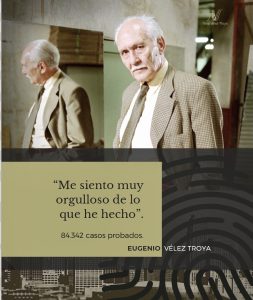
Por unanimidad y por tres veces consecutivas, fue nombrado Presidente para Europa de la Asociación Mundial de Detectives en México, Chicago y Barcelona. Entre otras aportaciones a la profesión, organizó en Barcelona el primer Congreso Mundial de Detectives celebrado en Europa -1961- e introdujo el detector de mentiras o polígrafo en España (1964). En 1984 la Brigada de Homicidios de la Jefatura Superior de Policía de Barcelona le otorgó una placa «por su eficiente labor profesional».
Con una larga experiencia en la vida judicial y profesional (intervino en 84.342 casos a lo largo de sesenta años de trabajo), se le considera entre los más expertos detectives privados españoles de la historia. En 1953, fundó la revista Detectives y en 1954, durante su estancia en los Estados Unidos, donde fue para ampliar sus conocimientos profesionales sobre dactiloscopia y examen pericial de documentos, fue nombrado miembro de la World Secret Service Association de EE. UU., formando parte del Comité Ejecutivo como delegado para Europa y África del Norte. También fue nombrado miembro de la Federation British of Detectives de Londres y de la Associated American Detectives Agencies de Nueva York. Asistió a diversas convenciones internacionales de detectives.Consiguió también el mérito y reconocimiento de la condecoración Épsilon de los servicios secretos. En el año 1998, el Gobierno de la Generalidad de Cataluña le concedió, asimismo, la medalla “President Macià” del trabajo.
En junio del 2002, se celebró un Congreso Internacional de Detectives en su tierra natal.
Autor del Manual Profesional «Los Detectives o Investigadores Privados» y del libro de sus casos más relevantes a nivel personal, «Las Otras Huellas».
El 15 de mayo de 2007 murió a los 86 años, dejando un legado de 84.342 casos en los que había trabajado a lo largo de su vida profesional, tanto para políticos, aristócratas y empresarios nacionales e internacionales. Antes de su muerte, recibió el Premio a toda su labor profesional por parte del Colegio Oficial de Detectives Privados de Cataluña, que sería su último Premio y que recibió de mis manos.
Todo este legado fue destruido por orden explícita de él para evitar que alguien pudiera hacer daño a otras personas.
El 14 de mayo de 2009 conseguí que pusieran su nombre a una calle y una placa conmemorativa en la casa donde nació, en Torre de Juan Abad (La Mancha).
Su «Sueño Americano» se hizo realidad entre los atardeceres de Time Square, las noches junto a Xavier Cugat y Joan Crawford y otros muchos famosos que brillaron junto a él en el Olimpo de los Sueños Cumplidos.

The American Dream of Eugenio Vélez Troya
“If you only have a name, you achieve nothing, but if behind that name there is a dream, a symbol, you become a legend.”

Pictures belong to the private collection of Eugenio Vélez Troya
As a journalist, it is not difficult for me to talk about famous people who have made a significant impact in their respective professions. However, discussing one of those individuals, who reached the pinnacle of his profession, being my father, is another matter entirely.
Eugenio Vélez Troya was born in Torre de Juan Abad in 1921 into a humble family consisting of his parents—my grandparents—and five children, of whom he was the eldest.
During his early years, his childhood was normal, like that of most children who played soccer in their limited free time, threw stones into ponds to create ripples, and took long walks in parks and anywhere else they could breathe in nature. But childhood is interrupted when reality sends you straight, at only eight years old, to tend sheep and be a shepherd at an age when you should be having fun with friends.
Perhaps that is why I am so proud of my father, because without realizing it, he built in his mind what he called over the years the “American Dream.”
“When the practice of a profession is carried out as a result of an intense vocation felt since youth, there is no force or difficulty that can divert us from the path that will lead us to the achievement of our aspirations,” Eugenio Vélez Troya.
In his early years, after moving with his family to Berga (Barcelona), he studied at the Colegio de los Hermanos de la Doctrina Cristiana, later pursuing studies at the Escuela Oficial de Náutica de Barcelona.
He worked as a teacher at the Escuelas Pías de Tarrasa and at the Colegio de los Hermanos Maristas del Paseo de San Juan in Barcelona, and his passion for the world of investigation soon began to emerge after a chance encounter with someone who told him about the profession of private detective.
As soon as he was able, he established a detective agency, “Detectives Vélez-Troya,” which was authorized and the first to be legally recognized in Spain. He managed to bring it to the forefront by developing intense activity in all branches of this interesting profession.
He pushed the government to enact the Ministerial Order regulating private investigation agencies.
Thanks to his solid experience in criminology and other fields of the profession, he was considered one of the most expert detectives in the world, and his organization had the most modern resources of the time and a team of specialized agents who, personally trained and under his direction, carried out the tasks entrusted to them with great success.
In August 1944, at the age of only twenty-three, he founded the DETECTIVES VÉLEZ-TROYA Agency. It was the first Spanish agency to conduct an extensive professional study in New York, Miami, and Cuba.
In 1954, he attended the International Congress of the British Association of Detectives in London as the first and only Spanish member, presenting a series of interesting papers that were accepted.
In 1955, he attended the World Congress of Detectives held in Mexico as the sole Spanish representative. And, for the first time, a Spanish—and European—detective was appointed President for Europe of the World Secret Service Association.
In 1956, he attended the World Convention of Detectives held in Las Vegas, Nevada.
In 1958, in Madrid, he was appointed European President of the 1st National Assembly of Detectives, and was also elected First President of the National Trade Union Board.
In the same year, he attended the World Convention of Detectives held in Chicago as European President.
In 1961, he was the sole promoter and organizer of the World Congress of Private Detectives held in Europe, specifically in Barcelona.
In 1962, he attended the World Convention of Detectives in Nashville, Tennessee, USA.
In 1964, he attended the World Congress held in Baltimore, USA, and was invited to visit the FBI in Washington.
In 1965, he traveled to Venezuela to study the private investigation methods of that country.
That same year, he represented the members of the World Secret Service Association of Spain at the Congress held in London.
In 1969, he officially represented Spanish detectives in Perpignan at the French Detectives Congress.
In 1970, he was also a founding member of the Spanish Association of Detectives, the Barcelona Association of Detectives, and president of the Catalan Professional Association of Private Detectives.
He was the first in Spain to introduce the “Lie Detector.”
He holds a diploma in Criminology from the National Institute of the American Police.
He holds a diploma in Criminology from the Boston School.
He has been awarded the Gold Plaque of the World Secret Service Association (WSSA).
Honorary Citizen of Nashville, Tennessee, and Golden Key to the City.
Honorary Sheriff of Davison County, Tennessee, USA.
Honorary Member of the Community of Mayors of New York State, Inc.
Honorary Member of the International Association of Women Police Officers.
Honorary Member of the American Association of Criminology.
Certificate of Merit from the North American Police Chiefs and Officers Association.
Member of the Fraternal Order of Lambda Epsilon Chi.
Diploma in Criminology from the Complutense University, in courses for detectives.
Silver Medal, 1st Class, for Professional Merit.

He was unanimously elected President for Europe of the World Association of Detectives in Mexico, Chicago, and Barcelona three times in a row. Among other contributions to the profession, he organized the first World Congress of Detectives held in Europe in Barcelona in 1961 and introduced the lie detector or polygraph in Spain in 1964. In 1984, the Homicide Squad of the Barcelona Police Headquarters awarded him a plaque “for his efficient professional work.”
With extensive experience in judicial and professional life (he was involved in 84,342 cases over sixty years of work), he is considered one of the most expert private detectives in Spanish history. In 1953, he founded the magazine Detectives, and in 1954, during his stay in the United States, where he went to expand his professional knowledge of fingerprinting and document examination, he was appointed a member of the World Secret Service Association of the US, serving on the Executive Committee as delegate for Europe and North Africa. He was also appointed a member of the Federation British of Detectives in London and the Associated American Detectives Agencies in New York. He attended various international detective conventions.He also earned the merit and recognition of the Épsilon award from the secret services. In 1998, the Government of Catalonia also awarded him the “President Macià” medal for work.
In June 2002, an International Congress of Detectives was held in his homeland.
Author of the professional manual “Detectives or Private Investigators” and the book of his most relevant cases on a personal level, “Las Otras Huellas” (The Other Footprints).
On May 15, 2007, he died at the age of 86, leaving behind a legacy of 84,342 cases he had worked on throughout his professional life, for politicians, aristocrats, and national and international businesspeople. Before his death, he received the Award for his entire professional career from the Official Association of Private Detectives of Catalonia, which would be his last award and which he received from my hands.
This entire legacy was destroyed by his explicit order to prevent anyone from harming other people.
On May 14, 2009, I managed to have a street named after him and a commemorative plaque placed on the house where he was born, in Torre de Juan Abad (La Mancha).
His “American Dream” came true amid the sunsets of Times Square, the nights spent with Xavier Cugat and Joan Crawford, and many other celebrities who shone alongside him in the Olympus of Fulfilled Dreams.