
En la cultura gastronómica española, el jamón puede ser uno de los emblemas más importantes, una joya para el paladar y un símbolo de la tradición, la cultura y la riqueza del buen comer de nuestro país.
Pero‚ para disfrutar completamente de su exquisito sabor‚ no basta solamente con disponer de un buen jamón, es importantísimo saber cortarlo correctamente. Un corte adecuado no sólo realzará el sabor y la textura‚ sino que también conseguirá el total aprovechamiento de la pieza.

Daniel Ellul es un profesional que ha comenzado recientemente en el proyecto de ser cortador de jamón, una profesión poco conocida y, por ende, poco valorada, aunque cada vez son más los que contratan este tipo de servicios para sus eventos. Y es que donde esté un buen jamón cortado a mano….
«Entre mis servicios se encuentran el corte y envasado al vacío de piezas de jamón, así como el servicio de corte en catering para bodas, comuniones, eventos, etc.»

Daniel Ellul ha cumplido el sueño de su vida profesional: convertirse en cortador de jamón, una profesión un tanto desconocida para la mayoría. Cuándo se dio cuenta de que realmente esa iba a ser la profesión elegida?
Mi nombre es Daniel Ellul. Comencé cortando jamón en casa de mis padres como cualquier persona y, más adelante, empecé a trabajar en un negocio que se dedica al corte de jamón. En este punto, creció mi interés hacia este mundillo.
¿Qué se necesita para ser un buen cortador de jamón?
Suena un poco a tópico, pero hay que tener mucha actitud, paciencia y constancia. Se trata de que te guste y de pasar horas y horas delante de una pata de jamón cortando. Al principio te crea un poco de impotencia. Las lonchas salen demasiado gruesas, desiguales, etc. Pero al fin y al cabo, se trata de práctica y manejo.
¿Supongo que en nuestro país sus servicios tienen más demanda que en otros lugares.
¿Cómo se ha iniciado la profesión en España? ¿Existe algún tipo de regulación? ¿Y en otros países?
Sí, existe alguna regulación para los cortadores de jamón, tanto en materia de higiene y seguridad alimentaria, como en relación con la venta del producto. Es más, existen también numerosos concursos y campeonatos de cortadores profesionales de jamón. En otros países no te podría decir si existe algún tipo de regulación, ya que nunca he trabajado en el extranjero, aunque no descarto esa opción.
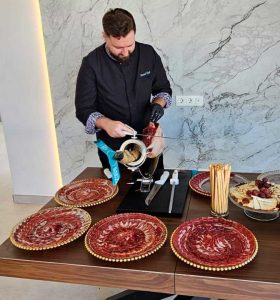
Como es un proyecto reciente en su vida profesional, supongo que no ha tenido mucho tiempo de acudir a grandes eventos o trabajar en el extranjero. ¿Le gustaría?
Al tener un trabajo regular de jornada completa, no dispongo de todo el tiempo que quisiera para mi emprendimiento. Pero de eso se trata, de dedicar todo el tiempo que me queda libre a este proyecto para que siga creciendo. Al principio hay que sacrificar algunas cosas, como el descanso o el tiempo que se dedica a algunos hobby. Tengo algo muy claro, quiero aprovechar todas las oportunidades que surjan, entre ellas, por supuesto, trabajar en eventos en el extranjero.
¿Qué herramientas son necesarias para un corte perfecto?
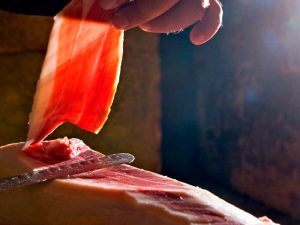
Las herramientas necesarias para el corte son, obviamente, los cuchillos. El cuchillo jamonero con el que cortamos las lonchas de jamón, el cuchillo pelador para limpiar el jamón, y el cuchillo «puntilla» para poder acceder a los recovecos donde no alcanza a llegar el cuchillo jamonero y así poder despegar el magro del hueso para sacar un corte limpio. Por supuesto, los cuchillos deben estar bien afilados. Sin unas herramientas buenas, no se le saca el máximo rendimiento a un jamón.
¿Qué características tiene que tener un jamón para ser bueno?
Para mí, el jamón perfecto está entre 7,5 kg y 8 kg y, obviamente, que sea 100% ibérico de raza. Es importante también palpar el jamón para ver si está crudo o seco antes de abrirlo. Para saber si está listo para consumir, al tocarlo por la parte de la cadera o de la babilla tiene que estar en un punto intermedio de dureza. También me suelo fijar en que el tobillo sea fino, ya que un compañero de profesión experimentado me enseñó que si la pata de jamón tiene tobillo fino, significa que el cerdo ha andando bastante durante su vida, es decir, el jamón va a tener una buena filtración de grasa en las lonchas.
¿Qué preparativos se han de realizar para el corte del jamón si el consumo va a ser
rápido o lento?
Si el consumo va a ser rápido, por ejemplo, un evento, lo suyo es cortarlo todo de golpe, ya que el jamón no pierde propiedades. Si el consumo fuera lento, recomendaría ir abriendo poco a poco las parte que se van a consumir, es decir, ir quitando la corteza de dicha parte, ya que la piel protege y conserva el jamón sin perder sus propiedades y aromas y sin ponerse duro.
¿Cuáles son los errores más frecuentes al cortar el jamón?
El error más frecuente al cortar un jamón es que si no sabes cortarlo y no haces un corte recto y paralelo a la mesa o tabla, no se le saca el 100% de rendimiento al jamón. Otro error, sería, como ya he mencionado, utilizar cualquier tipo de cuchillo o cuchillos sin afilar.
¿Qué consejo daría a los cortadores de jamón amateurs?
Mi consejo es que si de verdad le gusta esta profesión que no la dejen, que practiquen, que se interesen por aprender y que no desistan. Que aunque al principio sea duro, hay que ser constante. Al fin y al cabo, como con todo en la vida.
Diferencia entre los diferentes tipos de jamón: Jamón Ibérico y Jamón Serrano
Se distinguen por la raza del cerdo y por su alimentación
El Jamón Ibérico hace referencia al cerdo ibérico que es una raza propia de la Península Ibérica, que basa su alimentación en bellotas y engorda libremente por la dehesa. Esto le genera un sabor único.
Se clasifica en bellota, cebo de campo y cebo, según su raza y alimentación.El Jamón Serrano, por el contrario, proviene de cerdos de raza blanca que son alimentados con piensos y el proceso de curación es más corto, por lo que su sabor es menos intenso, aunque muy sabroso también.
The Art of Ham Cutting
In Spanish gastronomic culture, ham may be one of the most important emblems, a jewel for the palate and a symbol of tradition, culture and the richness of good food in our country.
But, to fully enjoy its exquisite flavor, it is not enough just to have a good ham, it is very important to know how to cut it correctly. A proper cut will not only enhance the flavor and texture, but will also make full use of the piece.
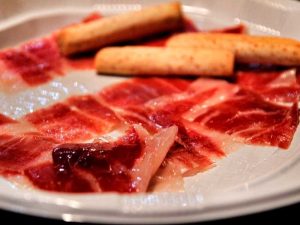
Daniel Ellul is a professional who has recently started in the project of being a ham cutter, a little known and therefore undervalued profession, although more and more people are hiring this type of services for their events. And is that where there is a good ham cut by hand ….
«Among my services are the cutting and vacuum packing of ham pieces, as well as the cutting service in catering for weddings, communions, events, etc.»
Daniel Ellul has fulfilled the dream of his professional life: to become a ham cutter, a profession somewhat unknown to most people. When did you realize that this was really going to be your chosen profession?
My name is Daniel Ellul. I started cutting ham at my parents’ house like anyone else, and later on I started working in a business dedicated to ham cutting. At this point, my interest in this world grew.
What does it take to be a good ham slicer?
It sounds a bit cliché, but you have to have a lot of attitude, patience and perseverance. You have to like it and spend hours and hours in front of a leg of ham slicing. At the beginning you feel a little helpless. The slices come out too thick, uneven, etc. But at the end of the day, it’s all about practice and management.
I suppose that in our country your services are more in demand than in other places.
How the profession started in Spain? Is there any kind of regulation, and in other countries?
Yes, there is some regulation for ham cutters, both in terms of hygiene and food safety, as well as in relation to the sale of the product. What’s more, there are also numerous competitions and championships for professional ham cutters. In other countries, I cannot tell you if there is any kind of regulation, since I have never worked abroad, although I do not rule out that option.
As this is a recent project in your professional life, I guess you haven’t had much time to go to big events or work abroad. Would you like to?
Having a regular full-time job, I don’t have as much time as I would like for my venture. But that’s what it’s all about, dedicating all the time I have free to this project so that it continues to grow. At the beginning, some things have to be sacrificed, such as rest or time dedicated to some hobbies. I have something very clear, I want to take advantage of all the opportunities that arise, including, of course, working on events abroad.
What tools are necessary for a perfect cut?
The necessary tools for slicing are, obviously, the knives. The ham knife with which we cut the ham slices, the peeler knife to clean the ham, and the “puntilla” knife to be able to access the nooks and crannies where the ham knife cannot reach and thus be able to remove the lean from the bone to get a clean cut. Of course the knives must be well sharpened. Without good tools, you can’t get the most out of a ham.
What characteristics does a ham have to have to be good?
For me, the perfect ham is between 7.5 kg and 8 kg and, obviously, 100% purebred Iberian. It is also important to feel the ham to see if it is raw or dry before opening it. To know if it is ready to eat, when I touch it by the hip or the stifle, it must be at an intermediate point of hardness. I also check to see if the ankle is thin, since an experienced colleague taught me that if the ham leg has a thin ankle, it means that the pig has walked a lot during its life, that is, the ham will have a good filtration of fat in the slices.
What preparations should be made for cutting the ham if it is to be consumed quickly or slowly?
If consumption is going to be fast, for example, an event, the best thing to do is to cut it all at once, since the ham does not lose its properties. If consumption is slow, I would recommend opening the parts to be consumed little by little, that is, removing the rind, since the skin protects and preserves the ham without losing its properties and aromas and without becoming hard.
What are the most frequent mistakes when slicing ham?
The most common mistake when slicing a ham is that if you do not know how to slice it and do not make a straight cut parallel to the table or board, you will not get 100% of the ham’s yield. Another mistake, as I have already mentioned, would be to use any type of knife or knives without sharpening them.
What advice would you give to amateur ham cutters?
My advice is that if you really like this profession, don’t give it up, practice, be interested in learning and don’t give up. Even if it’s hard at the beginning, you have to be constant. At the end of the day, as with everything in life.
Difference between the different types of ham: Iberian Ham and Serrano Ham
They are distinguished by the breed of pig and its diet.
Iberian Ham refers to the Iberian pig, which is a breed native to the Iberian Peninsula, which feeds on acorns and fattens freely in the pasture. This gives it a unique flavor.
It is classified as acorn-fed; cebo de campo and cebo, according to its breed and feed.Serrano ham, on the other hand, comes from white breed pigs that are fed with feed and the curing process is shorter, so its flavor is less intense, although also very tasty.